
BLOG
KATEGORİDEKİ DİĞER YAZILAR
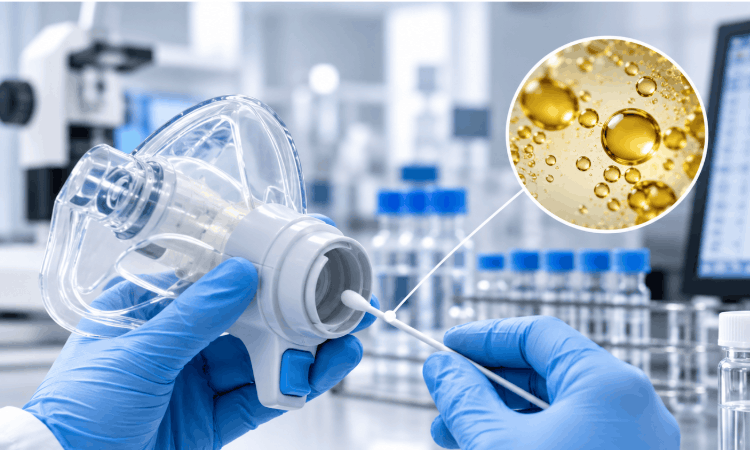
Lubricants, greases, and process oils used in the manufacturing processes of medical devices are chemical substances that must be carefully managed in terms of product safety, performance, and biocompatibility. These substances, which remain as residues on the device, can pose a safety risk when they come into contact with a patient or user. For this reason, oil residue analysis is a critical component of medical device quality assurance.
Oil and grease residues in medical devices can come from various sources:
Failure to properly remove these residues may adversely affect the device’s biocompatibility and functional performance.
Lubricant and grease residues may pose a risk of irritation, allergic reactions, or toxic effects when they come into contact with skin, tissue, or blood. Controlling residue levels is particularly important in invasive devices.
2. Biocompatibility RequirementsThe biological evaluation of medical devices under the ISO 10993 series includes the assessment of chemical residues. Oil residue analyses are an important part of this evaluation.
3. Validation of the Cleaning ProcessOil residue analyses contribute to the validation of the production process by measuring the effectiveness of the cleaning process applied.
4. Product PerformanceUncontrolled oil residues can negatively affect the device’s surface properties, adhesion behavior, optical performance, or sterilization efficacy.
5. Legal and Regulatory ComplianceUnder medical device regulations (MDR, FDA requirements), manufacturers are expected to control and document process-related residues.
Each type of oil may require different analytical approaches.
This method is based on extracting the sample with a suitable solvent, removing the solvent, and weighing the remaining residue. It is the primary method used to determine total oil residue.
Advantages: Simple, economical, and provides direct information about the total residue.
2. FTIR (Fourier Transform Infrared Spectroscopy)Used to identify the chemical structure of the oil residue and determine its type. Based on characteristic bands such as C-H, C=O, and O-H, an assessment is made as to whether the residue is oil-based.
3. GC-MS (Gas Chromatography-Mass Spectrometry)Used for detailed chemical profiling of oil components. It is particularly effective in identifying hydrocarbon components and determining the source of the residue.
4. HPLC (High-Performance Liquid Chromatography)It can be used to analyze additives, antioxidants, and polar components in oil.
5. TOC (Total Organic Carbon) AnalysisDetermines the total amount of organic residue in swab samples collected from surfaces using water or a suitable solvent. It is a method commonly used in cleaning validation.
6. Total Hydrocarbon AnalysisThis is a screening method designed to determine the total amount of hydrocarbon-based components in a sample. It is used for the general evaluation of oil and grease residues.
7. ICP-MS / ICP-OESIt can be used to identify metallic additives (zinc, calcium, magnesium, etc.) in lubricants. It provides supplementary information regarding the source of the residue.
In the production of medical devices, the cleaning process must be validated according to specific acceptance criteria. Oil residue analyses are used in this validation for:
As the Nanolab Laboratories Group, we provide technical support for oil and grease residue analysis in medical devices. We help you evaluate the cleaning effectiveness and residue profile of your devices in accordance with relevant standards and test methods.
You can contact Nanolab’s team of experts to determine the scope of analysis appropriate for your device’s design and intended use, clarify sample collection conditions, and support your cleaning validation processes.
For all your requests, contact us.
For the latest news and updates about our services, follow us on LinkedIn.
To stay updated on our latest blog posts, follow our Instagram account.