Nanoplastics: Invisible Particles and Unknown Risks
What Are Nanoplastics?
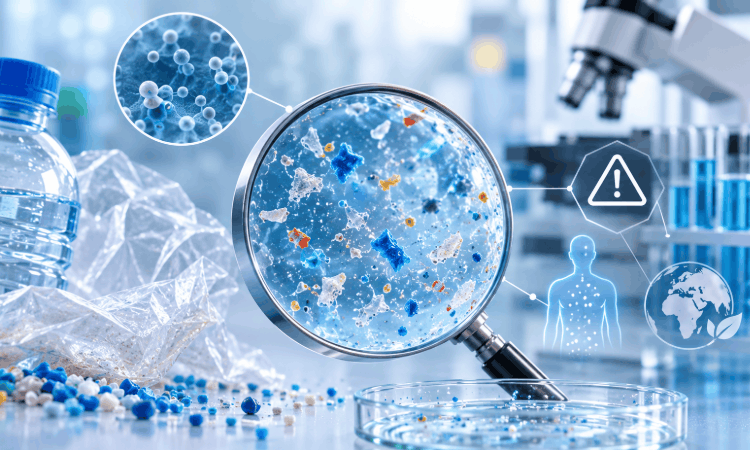
Nanoplastics: Invisible Particles and Unknown Risks
When we hear the term “plastic pollution”, the first images that come to mind are usually large pieces of debris accumulating in the oceans or small particles known as microplastics. However, there is a much smaller and far less well-known aspect to this issue: nanoplastics. Because of their size, these particles—which cannot be easily detected by the naked eye or with conventional methods—constitute the quietest yet most striking layer of plastic pollution.
What Are Nanoplastics?
Nanoplastics are generally defined as plastic particles smaller than 1 micrometer. Some sources set the upper limit at 100 nanometers. Microplastics, on the other hand, encompass particles ranging from 1 micrometer to 5 millimeters. Thus, nanoplastics correspond to a size range that falls below the microplastic scale and is often detectable only with specialized equipment.
This size difference is not merely a numerical detail. Nanoplastics:
- have a much larger surface area per unit volume,
- behave differently in the environment and biological systems,
- are more likely to interact with chemical substances,
- and are significantly harder to detect in the environment and living systems.
How Are Nanoplastics Formed?
The sources of nanoplastics can be categorized into two main groups:
Directly Produced Particles
In some industrial applications, polymer particles at the nanoscale are intentionally produced or used. These particles can enter the environment or the food chain throughout a product’s life cycle.
Particles Formed as a Result of Degradation
Nanoplastics emerge as larger plastic pieces and microplastics gradually break down due to sunlight, heat, mechanical wear, moisture, and microbial activity. This process causes plastic pollution to become “invisible” over time.
The Role of Nanoplastics in the Food and Water Chains
Nanoplastics can enter the food and water chains through similar pathways as microplastics; however, due to their small size, their presence is much harder to detect:
- Bottled drinking water: The presence of nano-sized particles in plastic bottles is one of the topics under evaluation.
- Food packaging: Research is being conducted on the potential for nano-sized particles to migrate from the surface of plastic packaging into food.
- Seafood: Nanoplastics in aquatic environments can enter the food chain through marine life.
- Processing equipment: Wear and tear on plastic surfaces in food processing lines can lead to the release of nanoplastics.
- Agricultural applications: Research is being conducted on the potential for plastic particles accumulating in soil to reach plant products.
Health Concerns
The effects of nanoplastics on human health have not yet been fully elucidated. The following are the primary areas of concern in the scientific community:
- Size advantage: Nanoplastics have a higher potential to cross biological barriers than microplastics.
- Cellular interactions: The likelihood of them interacting with cell membranes and intracellular structures is being evaluated.
- Chemical transport: They may play a role in transporting chemicals that can adhere to their surfaces.
- Additives: The release of certain additives present in the plastic matrix may be a concern.
- Long-term exposure: The long-term effects of daily, low-dose exposure are still under investigation.
Why Are Nanoplastics Hard to Track?
There are several key reasons behind the limited knowledge of the presence of nanoplastics in the environment and the food chain:
- Size barrier: The particles are smaller than the scale detectable by many commonly used methods.
- Very small masses: Environmental monitoring is difficult because the total amount is extremely low.
- Tendency to agglomerate: Nanoplastics can combine with organic and inorganic materials to form different structures.
- Diversity of sources: Different types of plastics and varying degradation pathways make a uniform assessment difficult.
- Lack of common standards: International common approaches to this issue are still under development.
Regulatory Status and Future Outlook
There are currently no binding international limits for nanoplastics. Specific numerical limits for nanoplastics have not yet been established in food and drinking water regulations. However;
- General regulations addressing plastic pollution indirectly cover the issue of nanoplastics as well.
- International organizations continue to keep the issue on their scientific agendas.
- As scientific data increases, regulatory approaches are expected to take shape.
Practical Recommendations for the Food and Packaging Industry
- Review your choice of packaging materials: Minimize plastic contact during hot filling, long-term storage, and with fatty foods.
- Evaluate process equipment: Regularly inspect plastic surfaces exposed to wear and tear.
- Supply chain transparency: Request material information from raw material and packaging suppliers.
- Adopt a preventive approach: Develop improvement plans based on risk assessments.
- Stay current with regulations: Regularly monitor scientific and regulatory developments.
Note: This article is for general informational purposes only. There are currently no internationally binding limits for nanoplastics; therefore, it is recommended to stay informed about the latest scientific and regulatory developments.
For all your inquiries, contact us.
For the latest news and updates about our services, you can follow us on LinkedIn.
To stay updated on our latest blog posts, follow our Instagram account.